UC/CX Vendor on the Key Trends and Predictions for 2026


As analysts, we’re always asked for our year-end predictions, so I thought I would turn the tables around and ask the vendors for their predictions. Here are some of the key trends and predictions for 2026 from various business communication vendors.
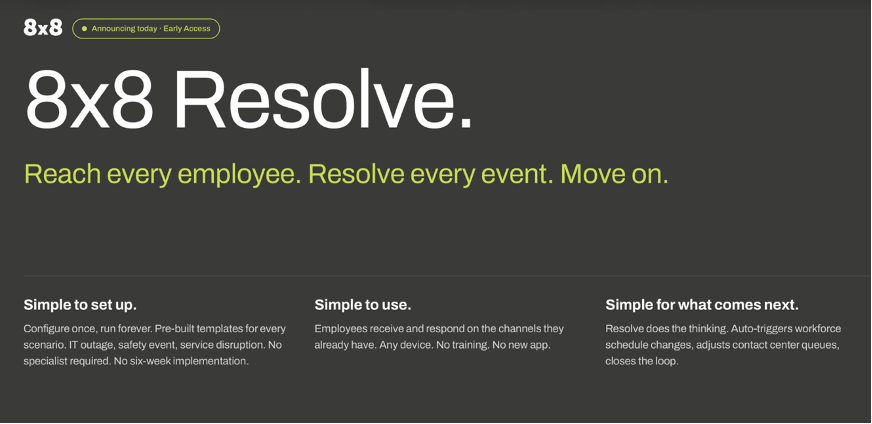
8x8 – The platform becomes the value
According to 8x8 CEO Sam Wilson, “The market finally stops treating business communications as a smorgasbord of disconnected products. UCaaS, CCaaS, and CPaaS served their purpose as labels, but customers are no longer interested in buying a category. They are buying platforms that unify the communication journey. The platform becomes the value. Applications become interchangeable.”
Cisco – Connected Intelligence is how things get done
Cisco notes that perhaps the most overarching workplace trend in 2026 will be around what Cisco calls Connected Intelligence. It's a new model of collaboration that connects people to people, people to AI, and, increasingly, AI to AI.
Aruna Ravichandran, SVP & CMO for AI, networking, and collaboration, notes: “By 2026, the workplace won't evolve through more apps or digital assistants, but through Connected Intelligence — where people, data, and digital workers [AI agents] work together side by side.Connected Intelligence removes the limits of geography and individual capacity. Knowledge and expertise move instantly to where they're needed. Digital workers surface insights in context, automate workflows quietly, and keep work moving forward — without interrupting human creativity or decision making.”
According to Vinod Muthukrishnan, VP & GM of Webex customer experience, "In 2026, the rapid evolution of AI multi-agent collaboration and orchestration will enable a new level of automation and the creation of brand concierge agents. Agentic AI will make it possible for workforces to be reimagined for a new era where these AI agents work side by side with human agents to deliver true connected intelligence and elevated customer experiences." He predicts that by 2026, these technological advancements will significantly transform the role of human agents, leading organizations to adopt new staffing models."AI-powered workforce engagement tools will be utilized, such as quality management and AI routing, and innovations in areas such as real-time speech-to-speech translation. These innovations will enable organizations to fundamentally transform how they manage and optimize hybrid teams of AI and human agents, allowing them to work together seamlessly and deliver true connected intelligence."
Dialpad – Agentic AI multiples, not replaces
Brian Peterson, CTO & Co-Founder, states, "I know this is a somewhat controversial take, but Agentic AI isn’t going to replace most of what businesses use. 90%+ of companies aren’t tech companies — they rely on their SaaS stack, and that stack is just going to get faster, easier, and more productive. AI doesn’t replace the tools or the expertise behind them; it multiplies both, which is why you’ll keep investing in the products you already run your business on."
Five9 – Battles and Consolidation
Matt McGinnis, VP of Product, Industry, and Solutions Marketing shares his 2026 predictions:
1. AI Agents begin scaled deployments and start to show large ROI.
2. Data becomes a big story to support hyper-personalization.
3. Agentic managerial tools will begin significant trials and find impactful use cases.
4. Battle between CX/CCaaS and CRM will heat up
5. Industry consolidation and PE activity will increase involving startup AI entrants, CCaaS platforms, CRM platforms, Workforce services, and UCaaS
Mitel - Control and trust will redefine the user experience
Eric Hanson, CMO predicts that the year 2026 will usher in a new era where users and organizations prioritize factors such as control, privacy, and security, while relegating convenience and user experience (UX) to the backseat. The age of AI and the increased threat surface of cybersecurity will require the introduction of a new UX frontier, one that requires greater safety, resiliency, and flexibility to meet the evolving global dynamics and the increased needs for multi cloud technology solutions and hybrid communications.
This shift will be felt at both the individual and organizational levels. As a new generation enters the workforce, we’ll see enterprises moving even further away from the “always on” mobile culture to champion more intentional, balanced connectivity. We can anticipate that this progression will reshape how people connect through technology, placing authenticity, trust, the protection of identity and intellectual property, and user choice at the center of preferred experiences. In response, enterprises will rethink how their technology ecosystems support connection, accelerating demand for delivering private-cloud and edge-based solutions across financial systems, communications, and AI. In 2026, success in enterprise communications will hinge on the ability to always being connected, safely, selectively, and with purpose.
And according to CTO Luiz Domingos, Chief Technology Officers will also become Chief Trust Officers. As AI becomes embedded in every process, product, and decision across the enterprise, trust is emerging as the defining measure of success. Simply building reliable systems is no longer enough; organizations must also earn confidence in how data is handled, automated decisions are made, and how technology aligns with shared values. The next generation of CTOs will act as Chief Trust Officers, striking a balance between innovation and integrity. They will champion transparency in AI models, establish clear governance frameworks, and ensure that ethical considerations guide every stage of design, deployment, and oversight. In an environment where AI adoption still faces a significant trust gap, confidence will become as important as delivering new capabilities.
Trust will become both a leadership mandate and a market differentiator. Organizations that succeed will treat responsible innovation not as a limitation but as a strategic advantage, proving that in the AI era, trust is the true currency of transformation.
Bill Dunnion, CISO, predicts that offensive security becomes the standard for defense, as traditional defensive postures—firewalls, monitoring, and compliance checklists—are no longer sufficient against threats that move faster and learn continuously. Offensive security practices such as red teaming, threat hunting, and penetration testing will evolve from optional exercises to essential functions of risk management. Mature organizations will integrate continuous testing into their operations, utilizing real-world attack simulations to enhance defenses and quantify risk in business terms.
Nextiva – AI agent collaboration will usher in a new era of CX
We predict that in 2026, AI-powered agents will be the force that finally collapses the traditional silos between the back office and the front office for businesses of all sizes. AI agents are quickly evolving from simple, customer-facing chatbots to embedded workers operating throughout the entire company, from finance and inventory to HR and service delivery. This ubiquitous presence means a customer-facing AI agent will be able to check an order status, initiate a refund, and adjust a delivery schedule in a single, seamless interaction, because the underlying AI has direct, real-time access to the back-office systems.
This widespread "AI agent collaboration" will lead to a new era of harmonious customer experiences. The customer will no longer feel the friction of a company's internal structure; they will simply experience the speed and satisfaction of a unified, intelligent organization.
NiCE - AI becomes the operating fabric of the experience, not an add-on or afterthought
Scott Russell, CEO, notes that “AI-first is the defining shift of our time. Traditional operations cannot keep pace with the exponential consumer. The future belongs to enterprises that embrace a unified AI platform, one that learns, adapts, and compounds value with every interaction.”
2026 trends include:
· AI-first becomes the dominant model for customer engagement
· Human-centric AI redefines how brands earn trust at scale
· Agentic AI and LAMs displace the traditional agent desktop
· End-to-end orchestration emerges as the core CX capability
· Workflows become the new applications
· AI agents collapse silos between front and back office
· Systems of engagement replace systems of record
· Connected intelligence fuels real-time insights for agentic systems
· Experience memory compounds AI value across customer journeys
· AI observability becomes mandatory for C-suite buy-in
RingCentral – Shift will come from making AI truly operational
Kira Makagon, President and Chief Operating Officer, notes that “AI is everywhere, yet nowhere. In 2026, the real shift will come from making AI truly operational. That means integrated systems, governed data, and intelligence that can understand human context at scale.”
Additional RingCentral predictions for how AI (and the organizations deploying it) will evolve in 2026:
Agentic AI becomes the new architecture of work. We’re entering a moment when autonomous, context-carrying agents (and Agentic Voice AI) become the connective tissue of modern business operations.
AI strategy management shifts from scattered to truly governed. Companies are realizing that AI cannot be confined to a single department and must operate with clear, organization-wide rules.
Human-AI teams become the new productivity engine
CX becomes the proving ground for orchestrated AI agents. CX will be the proving ground for agentic AI because the stakes are high and the potential payoffs are tremendous: shorter wait times, fewer escalations, consistent responses, cleaner handoffs, and customer experiences that don’t differ by the channel used.
When larger organizations adopt orchestrated systems (in which AI agents can pass context across workflows, applications, and teams), they’ll unlock efficiencies previously buried by their own complexity.
2026 is the year AI stops operating in silos. The advantage will shift to organizations that can effectively integrate AI as a cohesive system.
UJET – AI will prevent interactions from ever needing to happen
Matt Clare, VP Product Marketing, states that, “As I think about what's next for CX, I can't help but think there's more in store for AI. We (the industry vendors) have spent almost a decade trying to solve for interaction optimization with AI - both with virtual agent and human-assist use cases. Now that customer adoption is skyrocketing, I can't help but think that there'll be a shift to optimizing for use cases outside of the interactions. For example, we've seen AI agent assist tools deliver great value, but then you go visit an enterprise contact center and customer service reps still have 10+ apps open on their desktop. And we're seeing all these great quality management and analytics capabilities powered by AI now, but contact center administrators are still manually building, testing, deploying, and optimizing their CX operations.
The more I think about it, the more I feel like virtual agents, agent assist, and analytics are just the start for AI in the contact center. Lastly, I can't help but also be thinking that the industry has a lot more work to do preventing interactions from ever needing to happen, instead of optimizing for interactions. If I take off my technologist hat, my favorite companies are ALWAYS the ones I never have to talk to... so how do we use AI to drive more towards that as the new gold standard.”
Verint: Human and machine collaboration
Jaime Meritt, Chief Product Officer at Verint, predicts three key industry-shaping trends: the evolution of contact centers into data hubs, better collaboration between humans and machines, and matured AI technologies.
Contact Centers Evolve into Data Hubs: Forward-thinking organizations are treating contact centers as sources of customer insights that drive tangible business outcomes. By 2026, the strategic value of contact centers will be unmistakable. They will be data hubs that collect and organize information, then distribute it throughout the organization for better decision-making.
Improved Human-Machine Collaboration: In 2026, the most successful contact centers will facilitate seamless transitions between bots and live agents. In such scenarios, customer interactions flow from a bot to a human and back again – with full context, without requiring repeated information. Agents will also utilize bots for mundane tasks, quicker information retrieval and even answering questions in an agentic manner. This human-machine synergy will blend self-service with human-assisted workflows. This means automating routine requests and extending agent capacity to focus on complex issues that require emotional intelligence, creativity, problem-solving and critical thinking.
Matured AI Models: By 2026, contact center AI will move beyond the experimental phase into a more mature, value-oriented approach. Brands today don’t need more tools; they need more results: measurable, reliable outcomes and high ROI from their technology investment. Technology vendors will be under increased pressure to deliver measurable results faster and with clear ways to track performance, value and business impact. Enterprises are also setting policies, guidelines and quality controls to ensure that AI solutions are not just effective, but also secure and compliant. As contact centers handle more sensitive information, enterprise-grade data security and access controls will be even more important to ensure compliance with stringent regulations such as GDPR, CCPA, HIPAA and more. As a result, expect to see more advanced systems with granular access control and better integration between AI platforms and existing enterprise infrastructure.
Wildix – Voice is back, but so are security concerns
In 2026, voice returns not as nostalgia but as infrastructure. As voice reclaims its place at the center of service delivery, deepfake impersonation and synthetic voice fraud are systemic and no longer edge risks. In response, security will evolve from a feature into a philosophy. Trust evolves from compliance into competitive advantage.
Wildix CEO Steve Osler provided several predictions and insights:
AI Adoption Becomes a Competitive Requirement: AI will no longer be judged on conceptual brilliance or experimental promise but on what it delivers to the business. Businesses must begin planning AI adoption inside communications, not around it. For those not adopting AI, there is the risk of becoming less competitive than a direct competitor.
Security Becomes a Board-Level Priority in Communications: AI-powered impersonation, voice spoofing, and the rise in real-time communication threats accompany the rise of voice AI. Companies will need to take better security measures given the new ways of using AI to impersonate users.
Communication-Enabled Business Processes Surge: In 2026, the biggest shift will be automating the communication steps inside business processes, not just phone calls or chats.
AI Will Replace Tasks, Not Entire Workforces: AI takes over repetitive, high-volume tasks but enhances human roles.
Pricing Models Will Shift Toward Usage: Agentic AI consumes significant computing resources, requiring a model change. Steve predicts user licenses will eventually become free.
Wildix Chief Commercial Officer Jason Uslan added several channel-related predictions:
Managed Service providers (MSPs) will lead the redesign of communication experiences across the business. Successful MSPs will transform into consultants and understand their customers, their workflows, their employees. MSPs will need to verify where money is spent, what ROI is achieved, and whether workflows improve.
Workflow expertise becomes the new differentiator, and partners that can map workflows, identify friction, and implement targeted automation will win.
Channel ecosystems shift into consultative intelligence layers, helping businesses understand not just what to adopt, but why, where and how to use it responsibly and profitably.
2026 – Going from Hype to Business Outcomes
COMMfusion expects that 2026 will be all about data, workflows, and orchestration, with a focus on managing the combined human and AI agent workforce. We’ll see an increasing number of Agentic AI trials and deployments, with many successful outcomes, but also many public failures, as some companies rush to deploy agentic AI without proper testing. Expect to see several high-profile security breaches that will make some companies hesitant to deploy agentic AI, as vendors rush to highlight their security capabilities.
Real-world deployments will lag behind vendor hype, but businesses across multiple verticals will quickly move to take advantage of the potential cost savings and productivity enhancements that generative and agentic AI provides.
The companies that deploy AI for the right use cases (particularly for specific vertical markets), while providing the necessary training and user adoption strategies, along with proper guardrails, security, and governance, will transform their operations with positive outcomes for both employees and customers. There will be ups and downs along the way, but make no mistake – 2026 sets the stage for when agentic AI changes everything.